
Real intelligence is built in the real world.
WE FOCUS ON BUILDING HUMAN INTELLIGENCE TO THINK AND CREATE.
- SERVICE OVERVIEW
WHAT WE DO
Cognitrail Academy is a structured child-development environment where children learn through activity, interaction, challenges and guided reflection.
Instead of teaching children through lectures, we create controlled real-life situations in which children have to communicate, think, negotiate, make choices, solve problems, handle emotions and work with others.
Psychologists / trained facilitators observe these behaviours, guide children in real time and track their progress over time.
Activity → Observation → Assessment → Guidance → Practice → Progress
WHAT WE DON'T
Not Tuition.
Not Therapy.
Not Just an Activity Class.
Cognitrail Academy sits between education, psychology, coaching and experiential learning.
Children participate in enjoyable activities, but every activity has a developmental purpose.
Facilitators aren’t trying to create a particular personality.
The objective is to help children become more aware, adaptable, confident, capable and independent versions of themselves.
Cognitrail's Vision
Every Child Deserves a Clear Path.
Cognitrail’s long-term vision is to make child development measurable, understandable and actionable for parents, schools and coaches.The world tells parents what children should become. Cognitrail begins by understanding who the child already is.
Our Philosophy
Every child is different.
Development shouldn’t be one-size-fits-all.
Behaviour is information.
What children do can tell us what they need.
Experience shapes development.
Children develop through doing, not simply being told.
Progress needs to be visible.
What gets understood and measured can be developed more intentionally.
“Don’t try to change the child before you understand the child.”
Why Cognitrail Exists
The problem parents face:
- Children are often judged by marks, performance or behaviour.
- Parents see one side of the child; teachers and coaches may see another.
- A child may say “I don’t give up”, but behave differently when faced with failure.
- Many important abilities—resilience, emotional regulation, decision-making, confidence, adaptability—are difficult to understand through conventional testing.
We believe you cannot guide a child well until you understand the child well.
The Whole Child
The different dimensions that Cognitrail brings together.
Mind
Cognitive abilities, attention, memory, reasoning, decision-making and problem-solving.
Behaviour
Confidence, persistence, self-management, emotional regulation, adaptability and responsibility.
Social
Communication, teamwork, empathy, assertiveness, cooperation and leadership.
Body
Strength, speed, endurance, agility, coordination, flexibility and physical development.
A child is more than marks, medals or behaviour.
Our Methodology
ASSESS → OBSERVE → UNDERSTAND → EXPERIENCE → DEVELOP → TRACK
- Assess — Understand the child’s current abilities.
- Observe — See how they respond in real situations.
- Understand — Identify patterns and areas for growth.
- Experience — Use meaningful activities to create learning moments.
- Develop — Build stronger responses and abilities.
- Track — Measure progress over time.
Journey to Self-Awareness
“I am confident.”But observation may show hesitation in unfamiliar situations. Or:
“I never give up.”But observation may show that frustration causes them to stop trying. The purpose isn’t to tell the child they are wrong. It’s to help them notice themselves.
When children understand themselves, they can begin to change themselves.
Our Approach to AI & the Future
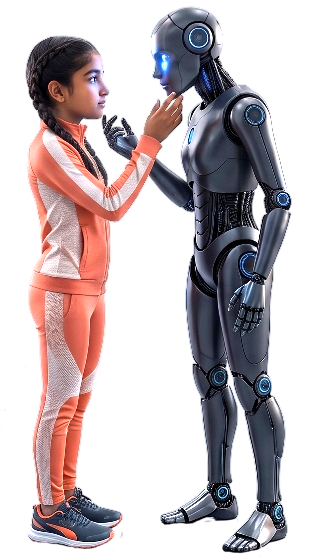
In an AI World, Human Intelligence Matters More Than Ever. We develop abilities AI cannot simply provide for a child:
AI can provide answers. Cognitrail helps children develop the intelligence to question, understand and use those answers wisely.
Physical Development
Strength
Speed
Endurance
Agility
Flexibility
Coordination
Cognitive Development
Attention & Concentration
Processing Speed
Problem Solving
Reasoning & Planning
Decision Making
Metacognition
Social Development
Communication
Cooperation
Social Confidence
Assertiveness
Empathy
Adaptability
Self-Management
Accountability
Persistence
Emotional Regulation
Independence
Discipline
Enterprising Abilities
Initiative
Creativity
Problem Ownership
Resourcefulness
Decision Making
Leadership
Communication
Responsibility
Influence
Team Management
Decision Making