
Neuro-psychological Development with active learning
designed by child psychologists and conducted by coaches.
- ACTIVITY OVERVIEW
Designed by Psychologists
Every session is built on a rigorous foundation of child psychology and developmental science, crafted by experts to target specific cognitive and behavioral milestones. However, theory alone isn’t enough—these frameworks are brought to life on the ground by elite sports and fitness coaches. These expert coaches know how to connect with children, turning high-energy movement into meaningful developmental breakthroughs.
Neuro-Developmental Focus
We target the brain’s foundational operating system—focusing on executive functions like working memory, cognitive flexibility, attention control, and processing speed. By building these neural pathways through active engagement, we help children process information faster, manage emotional impulses, and adapt seamlessly to new environments.
Activity-Based Learning
Children don’t learn or reveal their true behaviors by sitting still and filling out paper forms. Our sessions use dynamic physical activities, unscripted challenges, and games to put children into motion. This hands-on approach allows us to observe and build their resilience, motor skills, and problem-solving abilities where it matters most: in real-world scenarios.
Dynamic Group Settings
Growth doesn’t happen in isolation. By placing children in structured group settings, we unlock vital social dynamics. Coaches can observe how children interact with peers, handle collaborative pressure, navigate competitive situations, and step into leadership roles or work through conflicts in real time.
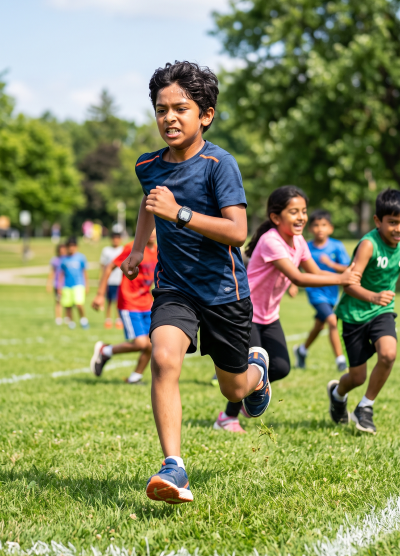
Watch session in progress
"While your child is simply having a great time, we are gently observing & improving how they move, think, and interact."
Decision Making
What does it mean for a child?
Decision making is the ability to consider available choices, think about what might happen next and select an appropriate action.
For example, a child has several ways to approach a situation and considers which option is most suitable rather than immediately choosing the first one.
Connection to Behaviour: Decision making supports responsible choices and self-management.
Connection to Fitness & Sport: It helps children choose an appropriate response during dynamic sports situations.
Connection to Learning: It supports evaluating information and applying knowledge.
Metacognition
What does it mean for a child?
Metacognition is essentially “thinking about your own thinking.”
It is a child’s ability to recognize:
What they know.
What they don’t understand.
What they are good at.
Where they need help.
Which strategy is working.
What they could do differently next time.
For example, instead of saying, “I can’t do this,” a child can say, “I understand the first part, but I need to try a different method for the second part.”
Connection to Behaviour: Metacognition supports self-awareness and self-correction.
Connection to Fitness & Sport: It helps children recognize weaknesses in a skill and adjust practice.
Connection to Learning: It supports self-directed learning, reflection, and using feedback effectively.
Processing Speed
What does it mean for a child?
Processing speed describes how efficiently a child can take in information, understand it and respond. It is not simply “being fast.”
For example, a child sees a signal, understands what it means, and responds appropriately.
Connection to Behaviour: Processing speed can influence how quickly a child responds to instructions without excessive delay.
Connection to Fitness & Sport: It supports reaction and response during movement.
Connection to Learning: It helps a child efficiently complete familiar cognitive tasks.
ENTERPRISING
What does it mean?
Enterprising behaviour describes a child’s tendency to take ownership, initiate action, explore opportunities, solve problems and take appropriate challenges.
For children, this does not mean being business-oriented.
It means developing the confidence to say:
“I’ll try.”
“I have an idea.”
“Let me find another way.”
Connection with Behaviour
Enterprising behaviour is strongly associated with:
Initiative + Independence + Responsibility + Persistence + Appropriate risk-taking
Connection with Fitness and Sport
Sport provides a natural environment for enterprising behaviour.
For example, a child may try a new skill, take responsibility for equipment, attempt a difficult movement, find a different way around a challenge or make decisions during play.
Connection with Learning
Enterprising behaviour supports curiosity, independent learning, experimentation, problem-solving and learning from failure.
Parent question: “Does my child take ownership and turn ideas into action?”
Problem Solving
What does it mean for a child?
Problem solving is the ability to understand a challenge, think of possible solutions, try an approach and adjust when necessary.
For example, a child cannot complete a task using the first method and tries another strategy rather than immediately asking an adult to do it.
Connection to Behaviour: Problem solving supports independence and persistence.
Connection to Fitness & Sport: It helps children find solutions during games and unfamiliar physical challenges.
Connection to Learning: It supports applying knowledge to new problems.
LEADERSHIP
What does it mean?
Leadership in children is the ability to positively influence, support, organize and guide others while taking responsibility for one’s own actions.
Leadership should not be confused with being loud, dominant, popular or always being “the captain.”
A quiet child who notices that someone is struggling and helps them can demonstrate meaningful leadership.
Connection with Behaviour
Leadership draws on:
Responsibility + Communication + Empathy + Decision-making + Initiative + Accountability
Connection with Fitness and Sport
Sport provides particularly rich opportunities to observe leadership:
Communication → Teamwork → Decision-making → Encouragement → Responsibility
A child doesn’t need to be the strongest or most skilled player to demonstrate leadership.
Connection with Learning
Leadership can support collaborative learning, group projects, peer mentoring, communication and independent responsibility.
Parent question: “How does my child positively influence and contribute to others?”
Reasoning
What does it mean for a child?
Reasoning is the ability to understand relationships, identify patterns and use information to reach a sensible conclusion.
For example, a child notices that when one action produces a particular result, changing that action may produce a different result.
Connection to Behaviour: Reasoning supports understanding consequences.
Connection to Fitness & Sport: It helps children recognize patterns in movement and anticipate what might happen next.
Connection to Learning: It supports mathematics, science, language, and analytical thinking.
Working memory
Working memory is the child’s ability to hold information in mind for a short period and use it while completing a task.
For example, a coach says, “Run to the cone, pass the ball, then return to your position.” The child has to remember the sequence while performing it.
Connection to Behaviour: Working memory supports following instructions and remembering rules.
Connection to Fitness & Sport: It helps children remember movement sequences and techniques.
Connection to Learning: It supports multi-step instructions, reading comprehension, and mental calculations.
Social learning
Working memory is the child’s ability to hold information in mind for a short period and use it while completing a task.
Social development is a child’s ability to understand and interact effectively with other people.
It includes much more than being outgoing or having many friends. A socially capable child can listen, communicate, cooperate, understand another person’s perspective, respect boundaries and manage disagreements.
Connection with Behaviour
Strong social skills can support cooperation, empathy, communication and constructive conflict management.
Connection with Fitness and Sport
Sport creates repeated opportunities for children to practice communication, cooperation, teamwork, respect and conflict management.
For example, a team game requires a child to communicate while also considering the actions of others.
Connection with Learning
Social competence can support peer learning, classroom participation, collaborative activities and asking teachers or peers for assistance.
Parent question: “How well does my child connect and work with others?”
From Assessment to Activity
Where the child is → What they need → What experience can help → How they respond → What to work on next
We don’t follow exactly the same development plan for every child.
Assessment and observation help us understand the current needs of the child.